
Table of Contents
ToggleIn 1971, the land that is now the UAE was a collection of seven small sheikhdoms with no shared army, no shared currency, and no real reason beyond geography to become one country.
Sheikh Zayed bin Sultan Al Nahyan changed that. Not through war or force, but through patience, long negotiations, and a stubborn belief that the region could be something different if its leaders stopped competing long enough to build something together.
Sixty years on, it’s worth asking what he actually built and whether it held.
The UAE founding story nobody tells straight
Most people don’t realize how close the whole thing came to falling apart.
The British were withdrawing from the Gulf in 1971 and the deadline was fixed. Several leaders weren’t convinced federation was the right move. Bahrain and Qatar walked away and went independent. Even among the seven that stayed, there were serious disagreements about who would hold power, who would lead, and what “unity” actually meant in practice.
Why Bahrain and Qatar walked away from the UAE union
The original negotiations included nine territories. Bahrain and Qatar had enough oil revenue to go it alone, and both chose to. Their departure nearly collapsed the whole project. What remained was a smaller, shakier coalition that still almost didn’t work.
How Abu Dhabi's oil money held the federation together
Sheikh Zayed’s contribution wasn’t just political. He put money behind the idea. Abu Dhabi had oil wealth. The other emirates didn’t, not at the same scale. He agreed to fund the federation from Abu Dhabi’s revenues, which meant he was personally subsidizing a project that others were skeptical of.
That’s the part people tend to skip. The UAE didn’t form because it was the obvious move. It formed because one leader was willing to carry most of the cost.
The 1971 deadline that made the UAE real
The British exit date wasn’t moving. That forced a decision that might otherwise have dragged on for years. In the end, a hard deadline did what diplomacy alone hadn’t managed.
What Sheikh Zayed actually believed in
A few things about him don’t fit the standard “founding father” biography.
Sheikh Zayed and the tree planting nobody expected
He was obsessed with growing things in a desert. He planted millions of trees in a country where trees had no business surviving. Green cover was a national priority for him the same way defence was a priority for others. A stubborn conviction, repeated over decades: the land could be different if someone kept at it long enough.
His environmental focus eventually shaped places like Jubail Mangrove Park in Abu Dhabi, which today draws thousands of visitors who want to see what a greener UAE actually looks like.
His foreign policy positions most people don't know about
He took foreign policy seriously in ways that went beyond the Gulf. He was vocal during the 1973 oil embargo. He sent aid to countries that had nothing to offer him strategically. He had positions on African development, on Palestinian rights, on what responsibility came with having resources when others didn’t.
What he said about oil wealth and responsibility
He had actual positions, some of them controversial, and he held them. His view that wealth accumulated without purpose is waste shaped how Abu Dhabi invested its revenues for decades after he was gone.
The UAE at 60: what got built and what didn't
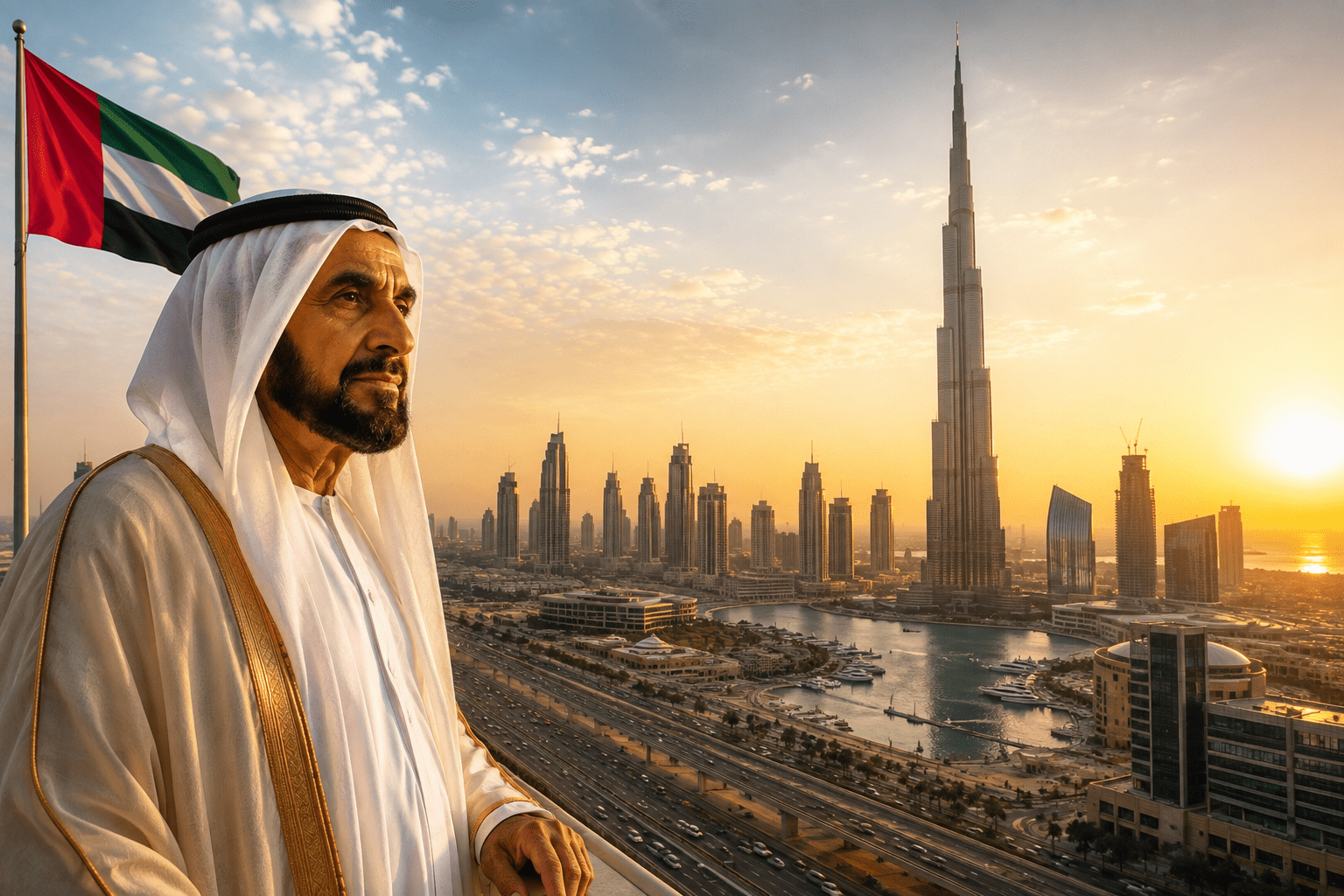
Dubai is the obvious answer when people want a shorthand for what the UAE became. The skyline, the tourism numbers, Formula 1, the financial hub. Real, but incomplete.
From pearl diving to global hub: how fast did it actually happen
The speed is genuinely difficult to absorb. The UAE went from subsistence fishing and pearl diving to one of the world’s busiest transit hubs within a single lifetime. People who grew up in fishing villages lived to watch Al Fahidi Historical Neighbourhood become a cultural landmark, preserved partly because everything surrounding it changed so completely.
The expat majority: what it means that 89% of the UAE isn't Emirati
About 88 to 89 percent of the population is expatriate. That number gets cited as a curiosity, but it’s a fairly radical experiment in what a country can be: a place where the vast majority of residents have no path to citizenship, yet where millions of people build careers, raise families, and stay for decades. For most of those people, figuring out the cost of living in Dubai in 2026 is the first practical question they ask before deciding whether to come at all.
Abu Dhabi's climate bets: Masdar and the net-zero commitment
Abu Dhabi built Masdar City, a planned zero-carbon urban district that predated most of the world’s serious climate infrastructure work. The UAE was among the first Gulf nations to commit to net-zero by 2050. Whether those targets hold is a separate question, but the direction has been set for years. How AI is transforming everyday life in the UAE is the next chapter of that same development model, technology carrying forward what oil revenues started.
Why Sheikh Zayed's legacy still matters today
The UAE is one of the few countries that went from nothing to a functioning global hub within a single lifetime. Not across generations. Within the lifespan of people who are still alive.
Sheikh Zayed is part of that story. So is the oil price spike of 1973, and the millions of workers who came from South Asia and East Africa and built things with their hands, and the British colonial decisions made decades before independence, and every leader who came after 2004.
A single person doesn’t build a country alone. Some people just move the story faster than others.
The Zayed National Museum in Abu Dhabi is the official attempt to tell that story in one place. Whether it tells the complicated version or the comfortable one is worth seeing for yourself.
The UAE at 60 is a real place: impressive in some ways, troubled in others, and still figuring out what kind of country it wants to be over the next 60 years.
Frequently Asked Questions (FAQ's)
The UAE’s first president and the leader who personally funded the 1971 federation from Abu Dhabi’s oil revenues when most other leaders remained skeptical it would hold together.
The UAE was founded on December 2, 1971, when six emirates signed the federation agreement, with Sheikh Zayed as first president; Ras Al Khaimah joined in February 1972.
The federation itself: convincing seven separate sheikhdoms to become one country and personally funding it until it could stand on its own.
He planted over 170 million trees across the desert and created wildlife reserves, work that laid the foundation for the UAE’s current net-zero by 2050 climate commitment.
Dubai’s skyline and tourism get the most attention, but Abu Dhabi carries real weight too, with the Louvre Abu Dhabi, Formula 1, Masdar City, and the Zayed National Museum among its international reference points.
