
Table of Contents
Toggle320 homes. All above $10 million. All sold in six months.
Dubai closed the first half of 2026 with 320 residential property sales above the $10 million threshold, a 23% increase on the same period in 2025, according to market analysis from Engel & Völkers Middle East. Combined, those transactions were worth $6 billion.
That volume arrived despite a stretch of slower buyer activity tied to regional uncertainty, which makes the number harder to wave away as simple momentum. The ultra-prime segment properties above $10 million accounted for 9.7% of Dubai’s total residential sales value in the first six months of the year. For a market this large, that share is not a rounding error. It reflects a structural shift in where serious capital is moving, and why it is staying.
What Luxury Real Estate in Dubai Actually Means
Luxury real estate in Dubai starts around AED 5 million in industry shorthand. The $10M-plus tier ultra-prime is a different conversation entirely. Buyers here are not stretching their budget. They are moving capital the way a fund manager moves between asset classes: deliberately, strategically, and almost always in cash.
What this tier actually buys:
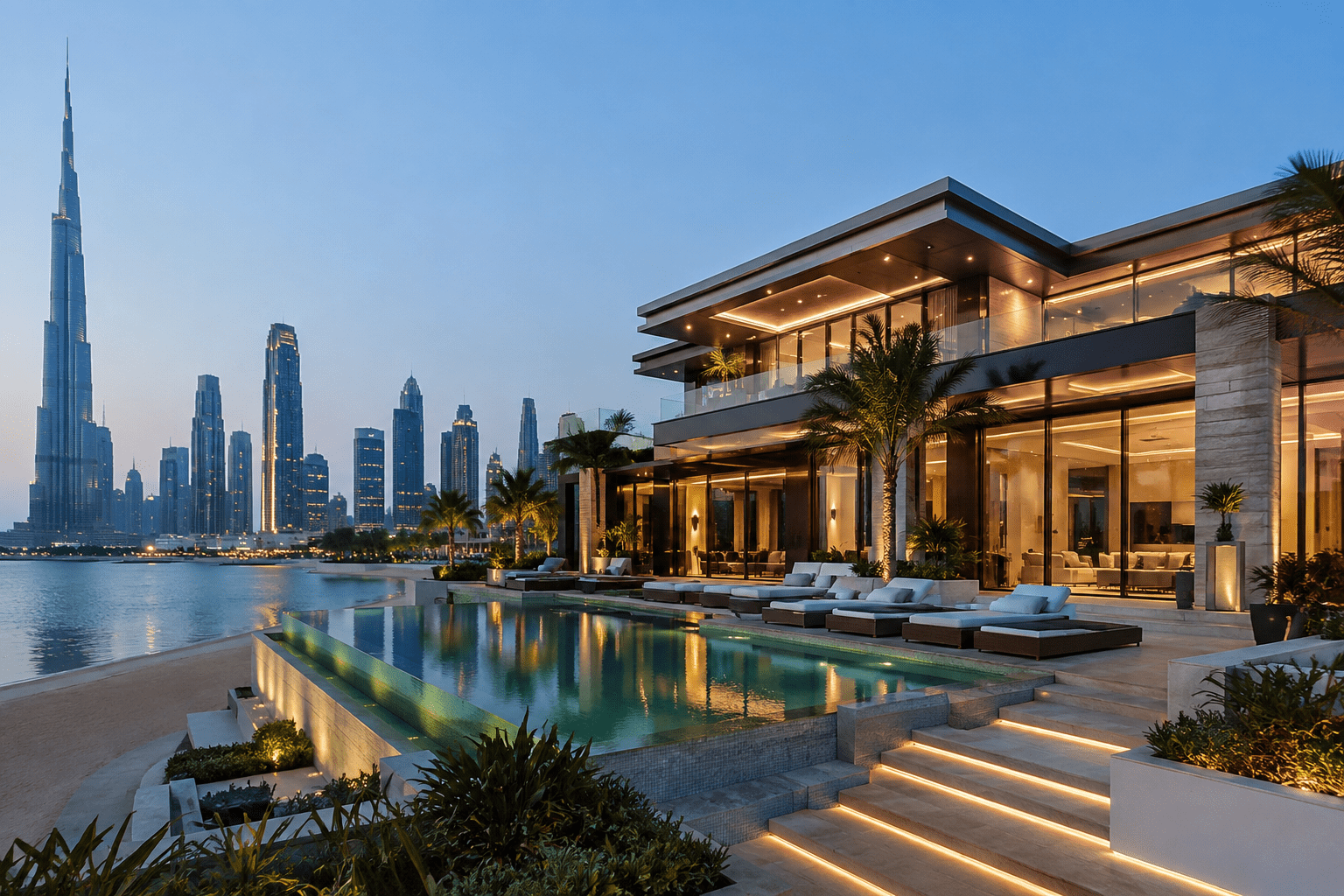
- Waterfront villas on Palm Jumeirah with five to seven bedrooms, private pools, and direct beach access
- Penthouses in Downtown Dubai overlooking the Burj Khalifa and Dubai Fountain
- Branded residences operated by Bulgari, Four Seasons, Aman, and Six Senses where the operator name commands a 20–35% premium over comparable non-branded stock
- Gated-community homes in Emirates Hills and Jumeirah Bay Island, where privacy is as much the product as the property itself
Foreign nationals can purchase freehold property in Dubai in designated zones with full legal title. No lease countdown. No surcharge for being an overseas buyer. The Dubai Land Department charges a flat 4% transfer fee regardless of nationality. That is not how it works in most cities competing for this type of buyer which is exactly the point.
Key freehold zones for overseas buyers: Palm Jumeirah · Emirates Hills · Jumeirah Bay Island · Downtown Dubai · Dubai Hills Estate · Dubai Marina · DIFC
Why 320 Transactions Happened in Six Months
Why 320 Transactions Happened in Six Months
Dubai offers no income tax, no capital gains tax on property, and no inheritance tax. For buyers sitting on serious wealth in countries where all three of those things are real and growing, Dubai’s position is not just convenient, it makes financial sense that is hard to argue with on a spreadsheet.
Then, in 2025, the landscape shifted further. The UK abolished its non-domicile tax regime, eliminating a structure that had made London one of the most attractive bases for globally mobile wealth for decades. Singapore introduced an Additional Buyer’s Stamp Duty of up to 60% for foreign purchasers. Neither policy was designed to catch ordinary buyers. Both landed squarely on the cohort already quietly asking their advisors what the alternatives looked like.
Competing Market Policy Comparison:
Market | Policy Change | Impact on Foreign Buyers |
United Kingdom | Non-dom regime abolished (2025) | Global income now taxable for long-term UK residents |
Singapore | ABSD raised to up to 60% for foreigners | Effective elimination of foreign buyer appetite at scale |
Canada | Foreign buyer ban extended (2023–2025) | Outright restriction in key markets |
Dubai, UAE | No change same flat 4% DLD fee | Consistent, nationality-neutral entry terms |
A meaningful share of those 320 Dubai luxury property sales are the result of decisions made in London boardrooms and Singapore tax offices, not just Dubai showrooms. Demand did not appear in 2026. It has been building since 2020, growing each time a competing market added friction.
The Golden Visa Turned Buyers into Residents
The UAE Golden Visa program grants a 10-year renewable residency to any buyer who invests AED 2 million or more in property. At the $10M tier, that qualification clears automatically on a single transaction. But the real effect is not on the paperwork it is on behaviour.
Golden Visa holders open UAE bank accounts, enrol children in international schools, register businesses, and buy cars. They stop being visitors. The downstream economic benefit to the UAE is substantial, and the property market captures the early signal of it.
The Henley & Partners Private Wealth Migration Report 2024 counted more than 6,700 high-net-worth individuals who relocated to the UAE that year more than any other country globally. A share of those individuals show up directly in the 320-transaction figure. Those who have not yet purchased are almost certainly in the market.
There Is Only So Much Palm Jumeirah to Sell
Who Is Actually Buying Dubai Luxury Property
The buyer profile has shifted meaningfully across three distinct waves since 2020. The first was dominated by British, German, and Scandinavian high-net-worth individuals. Many stayed, built lives, and became part of the fabric of Dubai’s international community. The second wave brought Indian ultra-high-net-worth families in significant numbers, now consistently one of the fastest-growing buyer segments at the $10M-plus level.
Indian buyers accounted for the largest single nationality group in Dubai residential sales above AED 5M for the third consecutive year in H1 2026, according to Dubai Land Department registration data. At the ultra-prime $10M+ tier, the same trend holds, with Indian UHNW families and family offices consistently appearing among the most active buyers on Palm Jumeirah and Jumeirah Bay Island.
What is newer, and increasingly significant, is the volume of American buyers. In 2020, a US national purchasing an ultra-prime Dubai property was an outlier. In 2026, Americans represent a statistically meaningful share of transactions driven partly by dollar strength, partly by the same wealth-preservation logic motivating buyers everywhere, and partly by growing familiarity with the UAE as a place that functions as a genuine global hub.
Buyer breakdown by origin:
- British, German & Scandinavian: Wave 1 (2020–2022). Many now permanent UAE residents with established lives and businesses in Dubai.
- Indian UHNW Families: Fastest-growing segment. Family offices and business owners dominate Palm Jumeirah and Jumeirah Bay Island transactions.
- Middle Eastern Family Offices: Longstanding at the upper tiers. Increasingly active in branded residences and off-plan ultra-luxury.
- American Buyers: Newest cohort in meaningful volume. Wealth preservation, UAE residency optionality, and dollar strength all contribute.
The common thread across all four groups: they are not buying primarily for rental yield. Dubai luxury property investment at this level is about holding wealth efficiently, maintaining residency optionality, and living somewhere that actually works at the standard they require. Yield is welcome. It is not why anyone writes a $15 million cheque.
What Ultra-Prime Buyers Are Actually Purchasing
Palm Jumeirah Villas
Frond villas in the $15M–$35M range remain the flagship product in Dubai’s ultra-prime market. Five to seven bedrooms, private pool, direct beach access, and a land footprint that is increasingly rare in a city building upward rather than outward. Many frond villa trades happen off-market via broker networks rather than public listings which means published transaction data almost certainly undercounts what is actually moving at this address.
Branded Residences
Branded residences have grown faster than almost any other category in Dubai’s luxury real estate market over the past three years. Buyers pay a 20–35% premium above comparable non-branded stock for the operator’s name, service standards, and facility management. Bulgari on Jumeirah Bay Island and Four Seasons Private Residences in DIFC are where the most serious demand in this category is landing in 2026. The Aman Residences pipeline is generating significant forward interest from buyers who would otherwise have considered the Maldives or Tokyo.
Off-Plan Ultra-Luxury
Off-plan at the ultra-prime level appeals to buyers who want to spread capital deployment across a longer horizon typically 20% on booking, with the remainder staged over three to five years post-handover. The risk is always developer delivery and timeline. For buyers who timed correctly in Dubai’s development cycle, the returns have been difficult to argue with. For buyers who did not, the lessons were expensive.
Due diligence on developer track record and escrow arrangements is non-negotiable at this tier. Under UAE law, developer funds must be held in a RERA-registered escrow account. Verify this before committing to any off-plan purchase.
What Buyers Need to Know Before Talking to an Agent
Freehold zones only. Full foreign ownership applies in designated areas: Palm Jumeirah, Emirates Hills, Downtown Dubai, Dubai Marina, Dubai Hills Estate, Jumeirah Bay Island, and DIFC, among others. Always confirm the zone status of any specific plot before proceeding.
The DLD transfer fee is 4%. Paid at registration. Applies to all transactions including off-plan. Not negotiable. Not variable by nationality.
Most $10M+ deals are cash. Non-resident mortgage financing exists, but maximum LTV sits around 50% and approval timelines are significantly longer than most domestic buyers expect. Anyone suggesting otherwise is being optimistic.
Agency commission is typically 2%. Paid by the buyer on secondary market purchases. On off-plan transactions, the developer typically covers the agent’s fee but always clarifies this in writing before signing anything.
Golden Visa eligibility is automatic above AED 2M. At the $10M+ tier, the 10-year renewable residency visa qualification is already there on a single transaction. The question is whether to activate it, not whether you qualify.
Off-plan escrow is mandatory by law. Developer funds must be held in a RERA-registered escrow account. Verify this before committing. Walk away from any arrangement that does not meet this requirement without exception.
Frequently Asked Questions (FAQ's)
Residential property above AED 5 million qualifies as luxury in Dubai, with ultra-prime transactions including the 320 recorded in H1 2026 taking place above $10 million in freehold communities like Palm Jumeirah, Emirates Hills, and Jumeirah Bay Island.
Zero property and capital gains taxes, the UAE Golden Visa, hard supply limits in premium locations, and buyers pushed out of London and Singapore by new foreign-buyer surcharges all hit at the same time.
Yes, foreign nationals can buy freehold property in designated zones with full legal title, paying the same 4% DLD transfer fee as any other buyer.
An investment of AED 2 million or more qualifies a buyer for a 10-year renewable residency visa; anyone buying at $10M+ clears this on a single transaction.
The structural drivers tax efficiency, limited ultra-prime supply, sustained high-net-worth migration remain intact, but global rate conditions and off-plan delivery risk are real factors every buyer should weigh before committing.
