
Table of Contents
ToggleMost people think of the Maldives or the Red Sea when they plan a dive trip. Dubai rarely comes up first.
That is a missed opportunity. The UAE sits within 90 minutes of Fujairah dive sites with real coral, marine life, and clear water. A short road trip adds Musandam in Oman, one of the most underrated dive areas in the region. And for anyone who wants to get certified first, a beginner dive course UAE operators offer can have you qualified and ready within a few days.
This guide covers everything: what scuba diving involves, the gear you need, scuba diving Dubai options, the best time to go, top global destinations, and safety basics.
What Is Scuba Diving?
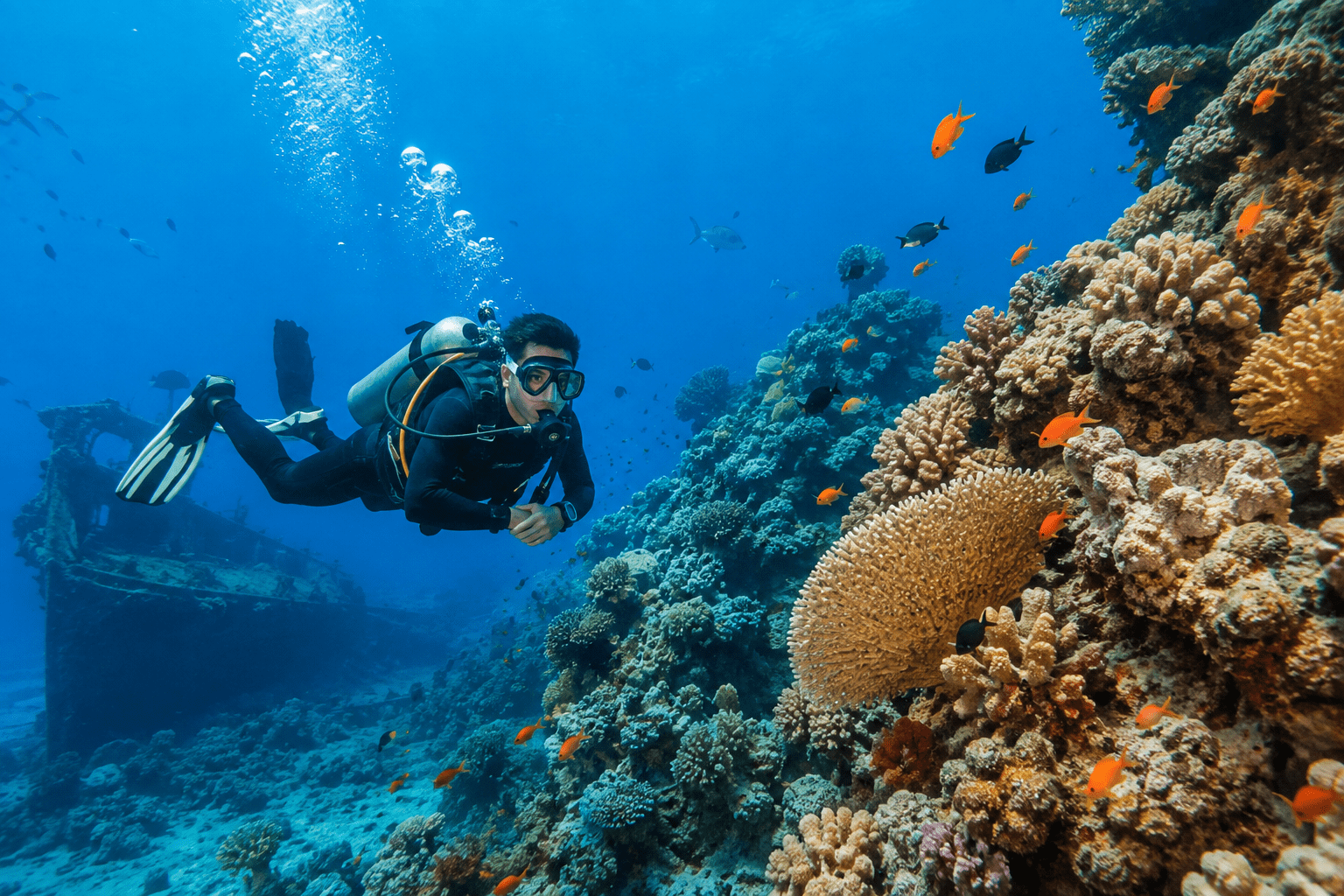
SCUBA stands for Self-Contained Underwater Breathing Apparatus. A cylinder of compressed gas attached to a regulator delivers air at the surrounding water pressure, so breathing underwater feels normal.
A buoyancy control device (BCD) lets the diver add or release air to maintain depth. A dive computer tracks depth, time, and decompression status throughout the dive.
Recreational diving covers depths up to 40 metres. A PADI Open Water or SSI Open Water certification is the standard starting point and is accepted by operators worldwide.
Essential Scuba Diving Gear
Most beginners rent a full kit from the operator. The table below shows what each piece does and what is worth buying early.
Equipment | What It Does | Rent or Own? |
Mask | Air space for clear vision underwater | Own (fit is personal) |
Fins | Propulsion with less effort | Rent or own |
Wetsuit | Thermal protection | Rent initially |
Regulator | Delivers breathing gas at depth | Rent, buy later |
BCD | Controls buoyancy | Rent initially |
Scuba Cylinder | Stores compressed gas | Operator-provided |
Dive Computer | Tracks depth, time, decompression | Worth buying early |
Weights + SMB | Ballast and surface marker | Usually included in rental |
A mask and dive computer are the two items worth buying before anything else. Everything else can be rented while you decide how seriously you want to pursue it.
Scuba Diving in Dubai: What to Know
The Arabian Gulf off Dubai is shallow, averaging around 35 metres at its deepest near dive boats. It is not a visibility record destination, but it has artificial reef structures and wrecks that attract grouper, rays, and sea turtles.
Licensed PADI Dubai operators run introductory experience dives for non-certified visitors in shallow, supervised conditions. These are not certifications. To dive independently you need a completed course.
Most UAE residents who dive regularly choose Fujairah on the Gulf of Oman coast. The Fujairah dive sites have stronger coral, better visibility, and more marine life than the Gulf side. Snoopy Island is the most accessible entry point for beginners. Musandam, about two hours by road, adds fjord-style sites with dolphins, reef sharks, and sea turtles.
Check the Dubai Department of Economy and Tourism (visitdubai.com) for licensed operator listings before booking.
Best Time for Scuba Diving in Dubai
October to April is the recommended window for the Arabian Gulf side. Visibility is better, water temperatures are comfortable with a 3mm wetsuit, and summer algae blooms are absent.
Fujairah and the Gulf of Oman hold more consistent conditions year-round. November to March is the sweet spot if you have flexibility on dates.
Beginner Dive Courses in the UAE
A beginner dive course UAE operators run typically takes three to four days. The structure across PADI and SSI is: theory (mostly online before arrival), pool sessions, then four open-water dives in supervised conditions.
What to confirm before booking:
- Instructors holding a current PADI or SSI certification ask to see it.
- Pool sessions happen before any open-water dive.
- Group sizes in the water stay small: four to six students per instructor for entry-level courses.
- The operator is willing to reschedule if sea conditions are unsuitable on the day.
Completing a course in the UAE gives you a certification card accepted by dive operators worldwide.
If you are planning a wider UAE coastal trip, the hidden beaches in Sharjah and Fujairah guide and the Ras Al Khaimah adventure guide cover other options across the region.
Best Scuba Diving Destinations for UAE Travellers
Dubai International connects directly or with one stop to all of the following destinations.
Destination | Best For | Visibility | From Dubai |
Fujairah, UAE | Reef, intro dives | 15–20 m | 90 min drive |
Musandam, Oman | Fjords, reef sharks | 15–25 m | ~2 hr drive |
Red Sea, Egypt | Reefs and wrecks | 20–30 m | ~3 hr flight |
Maldives | Drift, mantas, whale sharks | 20–30 m | ~3.5 hr flight |
Philippines | Wrecks, variety | 15–25 m | ~5 hr flight |
Great Barrier Reef | Scale, biodiversity | 15–25 m | ~12 hr flight |
Fujairah and Musandam are the obvious first choices for UAE residents. The Red Sea is the most popular international trip direct flight, strong coral, good visibility year-round. The Maldives suit drift and pelagic diving. The Philippines has the best wreck diving in the region. The Great Barrier Reef is the longest journey but delivers an unmatched scale.
For more UAE travel ideas, the UAE Weekly’s travel section covers destinations across all seven emirates.
Safety and Choosing an Operator
The biggest safety variable is usually the operator, not the ocean. These rules apply regardless of destination or experience level:
- Get certified before diving independently. A PADI or SSI open-water certification is not optional.
- Always dive with a buddy. No exceptions.
- Check equipment before entering the water: cylinder valve open, regulator delivering gas, BCD functioning.
- Agree on the dive plan before descending: depth limit, direction, and turnaround air level.
- Ascend slowly and follow your dive computer. A three-minute safety stop at five metres is standard.
- Cancel if conditions change. Poor visibility or unexpected current are valid reasons to stay out of the water.
When choosing an operator: confirm instructor certifications, check equipment condition, and make sure the safety briefing is mandatory and detailed. Operators who rush the briefing or are vague about credentials are worth avoiding.
For formal standards, PADI (padi.com) and SSI (divessi.com) both publish training requirements and let you verify instructor certification numbers.
Start Planning Your Dive
Scuba diving Dubai and the surrounding region is more accessible than most visitors realise. Fujairah is 90 minutes by road. Musandam is two hours. A beginner dive course UAE operators run can have you certified within a week.
Book with a licensed operator, complete the training properly, and the rest follows. For more Dubai travel planning, the things to do in Dubai guide and the family-friendly beaches guide cover the wider coastal picture.
Frequently Asked Questions (FAQ's)
Yes. Licensed operators offer supervised introductory dives for non-certified beginners in shallow water. For independent diving you need to complete a recognised open-water certification course first.
Snoopy Island off Al Aqah is the most widely used beginner site, with calm conditions, coral, and regular turtle sightings. Dibba Rock and Sandy Beach are also popular options. Confirm conditions with your operator on the day.
Fees vary by operator and what is included. Confirm whether eLearning, equipment rental, and all four open-water dives are in the quoted price before booking. Contact operators directly for current pricing.
October through April for the Arabian Gulf. November to March for Fujairah and the Gulf of Oman. Summer brings warmer water but reduced visibility on the Gulf side.
Most operators require a medical questionnaire. If you have any relevant medical history (heart, lung, or ear conditions), a doctor’s certificate is typically required. Confirm before booking.
Between 30 and 60 minutes on most recreational dives. Actual duration depends on depth, breathing rate, and cylinder size. Beginners often use air faster than experienced divers due to nerves. This normalises quickly.
