
Table of Contents
ToggleStep outside in Dubai or Abu Dhabi these days, and something feels different. Traffic signals adjust themselves. Banking apps anticipate your next move. Hospital queues feel shorter than they did a few years ago.
None of this is accidental. Artificial intelligence has quietly woven itself into the fabric of daily life across the Emirates, reshaping the lifestyle UAE residents have come to expect. Whether you’re a long-time resident, a recent arrival, or a tourist exploring the country for the first time, AI is working behind the scenes to make things faster, smarter, and noticeably more personal.
This isn’t just a tech story tucked away in business pages. It’s a UAE news story that touches healthcare, transport, education, banking, and even the way you pick up groceries on a Tuesday evening.
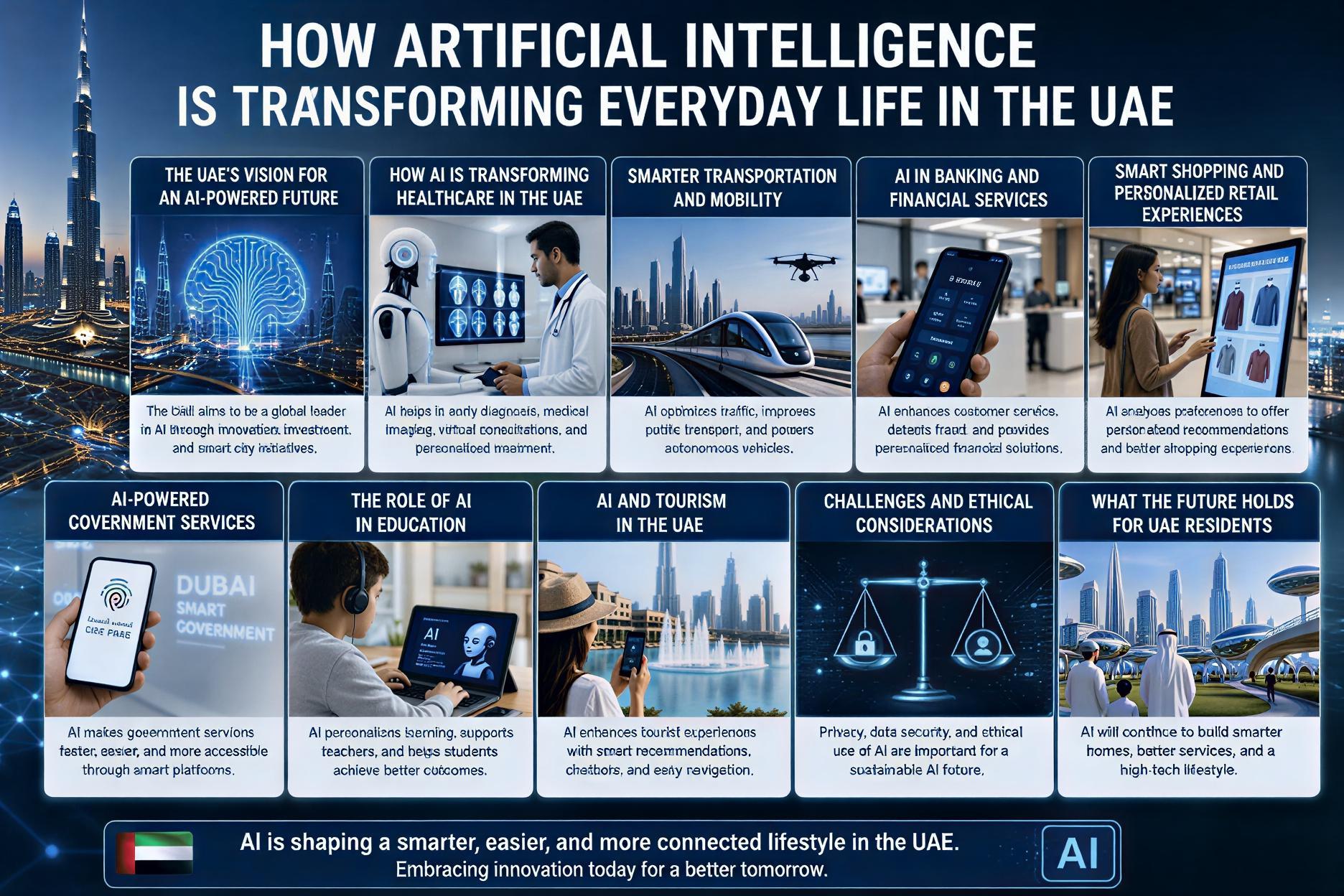
The UAE's Vision for an AI-Powered Future
The UAE government has been refreshingly direct about its ambitions. Back in 2017, it appointed the world’s first Minister of State for Artificial Intelligence, signalling early that AI in UAE wasn’t going to be a side project.
That early move has since grown into something far bigger. The UAE has unveiled plans to deploy Agentic AI across 50 per cent of federal government services and operations within two years, part of an initiative described as “UAE Government 4.0.” The plan includes training 80,000 federal employees in Agentic AI technologies and tools. Dubai continues to position itself as a proving ground for smart cities UAE initiatives, while Abu Dhabi has set a goal of making its government AI-native across all digital services by 2027.
What stands out is the practical framing. Officials talk less about AI as a concept and more about cutting paperwork, shortening wait times, and making services available at any hour.
How AI Is Transforming Healthcare in the UAE
Healthcare is where AI applications often feel most personal, because the stakes are higher and the results are harder to ignore.
In Dubai, Medcare Hospital Al Safa has introduced an AI-powered blood test that can predict coronary artery disease with around 95% accuracy, often before symptoms appear. For patients, that’s the difference between catching a problem early and finding out the hard way.
Tuberculosis screening has also been transformed by a tool called AIRIS-TB, which automates chest X-ray analysis, processes up to 2,000 images a day, and cuts radiologist workload by roughly 80%. That’s not a small efficiency gain; it’s the difference between a backlog and same-day results.
On the policy side, the National Unified Digital Licensing Platform now uses AI to centralise and streamline licensing for more than 200,000 healthcare professionals across the country, quietly affecting how quickly clinics can staff up and how reliably patients can verify a doctor’s credentials.
Generative AI tools are also being used in less flashy but genuinely useful ways. Hospitals are experimenting with AI-generated multilingual discharge instructions tailored to a patient’s existing conditions, along with draft clinic letters that pull context directly from electronic health records. For a country with such a diverse population, multilingual discharge notes alone solve a problem many residents have quietly struggled with for years.
Beyond diagnostics, chatbots now handle hospital bookings and patient engagement, while AI-enabled navigation systems support robotic surgery in several major facilities.
Smarter Transportation and Mobility
If you’ve used Dubai’s metro recently, you’ve likely benefited from AI transportation systems without realising it.
The RTA uses AI-driven traffic management platforms to monitor congestion patterns in real time and adjust signal timing across major junctions. Smart traffic signal systems respond to actual traffic volume rather than fixed schedules, which is part of why some of the city’s worst bottlenecks have eased over the past couple of years.
Autonomous vehicle trials continue to expand. Dubai has tested self-driving taxis and shuttles in select districts, while Abu Dhabi has piloted driverless shuttle buses on university campuses. These remain limited in scope, but they’re a clear signal of direction.
Even ride-hailing apps like Careem and Uber now lean on AI-based demand prediction, helping drivers position themselves ahead of surges and helping passengers get picked up faster during peak hours.
AI in Banking and Financial Services
Walk into most major banks in the UAE today, and there’s a good chance you’ll interact with AI before you ever speak to a human.
Emirates NBD’s chatbot “Eva” and ADCB’s virtual assistant handle routine queries around the clock, while fraud detection systems flag suspicious transactions within seconds rather than days. For residents, that means faster loan approvals, quicker dispute resolution, and apps that genuinely feel tailored to how they spend.
Smaller fintech players in Dubai’s financial free zones are also building AI-driven budgeting and investment tools, an area particularly relevant given the UAE’s large expat population, many of whom are managing finances across two or more countries at once.
Smart Shopping and Personalised Retail Experiences
Shopping has always been something of a national pastime in the UAE, and AI is making the experience more personal than it’s ever been.
Malls like Dubai Mall and Mall of the Emirates use AI-powered footfall analytics to understand crowd movement and adjust store layouts or promotions accordingly. Retailers increasingly rely on recommendation engines to suggest products based on browsing and purchase history. Some beauty retailers have introduced AI-powered smart mirrors that let shoppers virtually try on makeup or outfits before buying, while price-comparison tools quietly scan multiple retailers in the background to surface the best deal.
For tourists, the result feels less like browsing and more like being guided by someone who already has a sense of what they’re after.
AI-Powered Government Services
This is arguably where smart government services have made the most visible difference to everyday life.
Dubai’s government apps now let residents renew visas, pay fines, and access well over a thousand services without setting foot in an office. Many of these platforms run on AI chatbots capable of guiding users through processes in multiple languages, which matters enormously in a country where dozens of nationalities live side by side.
Abu Dhabi’s TAMM platform consolidates government services into a single digital hub, with AI helping route requests to the correct department instantly rather than bouncing residents between counters.
At the federal level, the Cabinet has also approved drafting a federal law to regulate smart health applications and AI use in healthcare, covering licensing, safety, patient rights, and legal liability. Even immigration has been reshaped: Smart Gate systems at airports use AI-powered facial recognition to clear passengers in seconds rather than the minutes it used to take.
The Role of AI in Education
Classrooms across the UAE are changing, though the shift here has been more gradual.
Officials have framed education as the backbone of the UAE’s AI strategy, with university programmes specifically designed to prepare an AI-ready workforce. Schools increasingly use adaptive learning platforms that adjust lesson difficulty based on individual student performance, flagging areas where a student might be falling behind before it becomes a bigger problem.
During remote learning periods, AI-based engagement tracking tools helped teachers spot disengaged students early. Many of these tools have stayed in use even after classrooms returned to normal, simply because they worked.
Universities in Dubai and Sharjah have also added AI-focused coursework across departments, on the logic that future job markets will expect at least baseline familiarity with these tools regardless of a student’s main field of study.
AI and Tourism in the UAE
For visitors, AI has made exploring the UAE noticeably smoother, even if most tourists never notice the technology directly.
Hotels increasingly use AI chatbot concierges for bookings and guest queries, often available in multiple languages around the clock. Some properties in Dubai have introduced AI-controlled smart rooms that adjust lighting, temperature, and entertainment automatically based on guest preferences from previous stays.
Tourism boards in Sharjah, Ras Al Khaimah, and Abu Dhabi have started using AI-based recommendation tools to personalise itineraries, suggesting experiences based on a visitor’s actual interests rather than generic “top ten” lists. Airports have also leaned into AI for baggage handling and queue management, shaving minutes off processes that used to feel endless.
What the Future Holds for UAE Residents
Looking ahead, the most likely shift is that AI becomes even less visible, in a good way.
Home automation is expected to expand further, with smart homes increasingly using AI to manage energy use, security, and daily routines without anyone touching a switch. Voice assistants are likely to support more local dialects, making them genuinely useful for a wider range of residents.
Healthcare predictions could become more proactive still, potentially flagging risks before symptoms ever show up. Dubai’s AI healthcare market alone is projected to grow at a 34.6% CAGR, reaching around US$138 million by 2030.
The common thread running through all of this is convenience, the kind that fades into the background until you stop and realise life has simply gotten easier.
Final Thoughts
From hospital diagnostics to grocery shopping, from visa renewals to hotel check-ins, artificial intelligence has become part of the everyday lifestyle UAE residents and visitors now take for granted. This isn’t a future scenario. It’s happening now, across every Emirate, in ways both dramatic and easy to miss.
As AI in the UAE continues to evolve, staying informed isn’t just interesting; it’s genuinely useful. Understanding how these changes affect your healthcare, your finances, your commute, and your shopping habits helps you make better decisions day to day.
Frequently Asked Questions (FAQ's)
Tools like AIRIS-TB for tuberculosis screening and Medcare’s AI blood test for coronary disease prediction are already in use across Dubai hospitals.
It’s an AI system the UAE plans to deploy across 50% of federal government services, with 80,000 employees being trained to use it.
Not yet, but Abu Dhabi aims to make all its digital government services AI-native by 2027.
Emirates NBD uses a chatbot called Eva, while ADCB and other banks operate similar AI-driven virtual assistants for customer service.
Smart Gate uses AI-powered facial recognition to clear passengers through immigration in seconds without manual checks.
