
Table of Contents
ToggleSharjah Airport is the kind of place that people have strong feelings about, mostly because they weren’t expecting it to be what it is. If you’ve flown Air Arabia, you’ve been here. If you’re connecting from South Asia, Central Asia, or East Africa on a budget carrier, there’s a good chance you’ll be here soon. It’s busy, it’s compact, and once you know how it works, it’s genuinely easy to navigate.
This guide covers everything: flight status, terminal layout, check-in timings, what the landside and airside areas actually look like, how to get into Sharjah or Dubai from the airport, and what your options are if your layover stretches longer than planned.
Quick Facts: Sharjah International Airport (SHJ)
- IATA code: SHJ
- ICAO code: OMSJ
- Location: About 10 km from Sharjah city centre, 15 km from Dubai
- Number of terminals: One main terminal handling all domestic and international traffic
- Home airline: Air Arabia
- Cargo hub: Yes, SHJ is one of the UAE’s main air cargo facilities
- Airport authority website: sharjahairport.ae
- Customer helpline: +971 6 558 1111
How to Check Sharjah Airport Flight Status
The most reliable place to check Sharjah Airport flight status is the airport’s own arrivals and departures board at sharjahairport.ae. This pulls directly from the airline operations system and will reflect gate assignments and delays faster than most aggregator sites.
For live aircraft tracking (position data, altitude, speed, estimated landing time), Flightradar24 and FlightAware are the tools most frequent travellers use. They’re particularly useful when a flight is still airborne and the airport system is still showing “on time” rather than an updated status.
When to check and when to stop refreshing:
Check flight status the night before to catch any schedule changes published by the airline. Check again two to three hours before departure or arrival. Anything between those windows is usually stable unless weather or operational issues intervene.
Airport-side timings you should know:
- Domestic flights: check-in opens 2 hours before departure, closes 45 minutes before
- International flights: check-in opens 3 hours before departure, closes 60 minutes before
- Self-transfer connections (arriving on one ticket, departing on another): leave at least 2.5 to 3 hours between flights. You’ll need to collect your baggage, exit, re-check in, and clear departures security again; this isn’t a protected connection the way a code-share would be
- Picking someone up: international arrivals typically take 45–75 minutes from touchdown to the exit doors, factoring in immigration queues and baggage claim. Domestic arrivals are faster, around 20–30 minutes
Terminal Layout: What the Airport Actually Looks Like
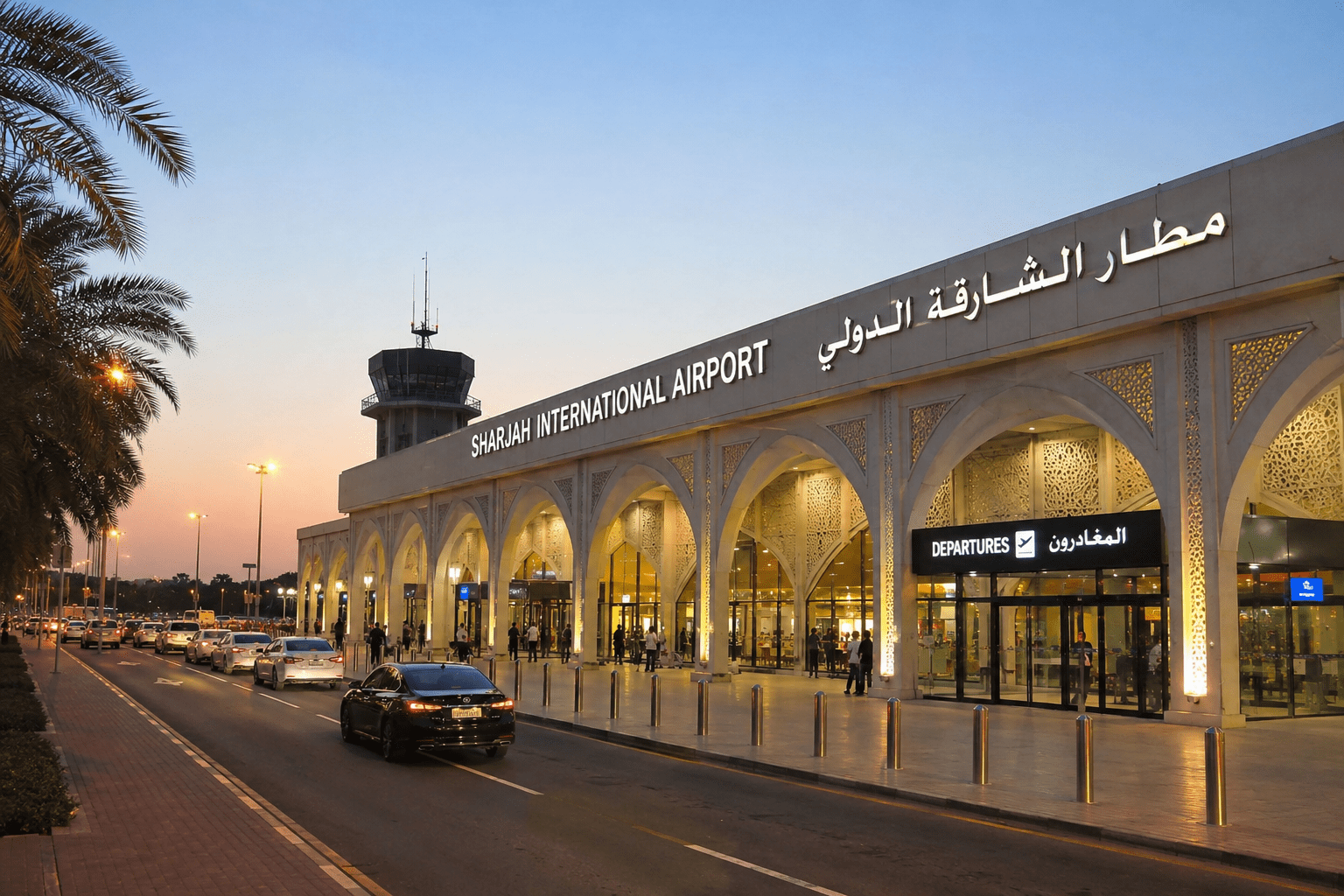
Sharjah International Airport operates from a single terminal building, which is both its biggest advantage and its main constraint. There’s no inter-terminal transfer, no train, no 20-minute walk between concourses. You arrive, you check in, you go through security, and you’re in the single departure hall.
Departures level (level 1):
Check-in counters run along the ground floor of the terminal. Air Arabia counters are the most extensive and occupy the largest section of the hall. Other airlines, Qatar Airways, IndiGo, flydubai, and various Central Asian carriers, have allocated counters in adjacent sections. There are self-service kiosks for Air Arabia passengers who’ve already checked in online and need only to drop bags.
After check-in, the security checkpoint leads into the departure area. Gates are numbered and signposted clearly, though the terminal can feel cramped during the early morning departure bank when a high volume of South Asian regional flights all push back within a similar window. If your gate is at the far end and you’ve stopped at a cafe, keep an eye on the time.
Airside (post-security):
Once through security, you’ll find a duty-free area with the usual categories: perfume, cosmetics, confectionery, electronics accessories. Alcohol is available but the selection is limited and the prices are not notably better than downtown. There’s a Starbucks airside, a food court area with a mix of grab-and-go Arabic food and fast food options, and seating that fills up during peak hours. If you want a seat during the 6am–9am departure window, get airside early.
Prayer rooms are signposted throughout the terminal on both levels. Smoking rooms are located at specific points airside.
Arrivals level:
Arrivals for international flights feed into a single immigration hall with separate queues for UAE nationals, GCC nationals, and all other passports. During peak arrival windows, typically early morning and late evening, the all-other-passports queue can be slow. Factor 45–60 minutes from landing to the exit doors if you’re arriving internationally during these hours.
After immigration, baggage claim carousels are clearly numbered and belt assignments are displayed on overhead screens. Car rental desks (Budget, Europcar, and others) are located in the arrivals hall landside. There’s a tourist information point and a currency exchange counter to the left of the exit doors.
Lounge Access at Sharjah Airport
The airport has one main lounge, the Air Arabia Lounge, located airside past security. Access is available to Air Arabia Plus Gold and Platinum card members, business class passengers on participating airlines, and holders of eligible Priority Pass memberships.
The lounge is a modest facility by international standards: seating for around 80–100 people, a buffet with hot and cold options, soft drinks, tea and coffee, and a basic business section with desktop computers and Wi-Fi. It’s not luxurious, but for a 3–5 hour layover it makes a meaningful difference in comfort.
For passengers without lounge access on longer layovers, the airside seating areas and food court are the main alternatives. The food court option works fine; the seating congestion during morning peaks is the only real issue.
Services for Long Layovers
If your connection is six hours or longer or if you’ve got a night to kill Sharjah Airport and Air Arabia both run options that make that time usable rather than just endurable.
Stopover tours: Sharjah Airport organises guided half-day and full-day tours of the emirate for transit passengers with sufficient layover time. These typically cover the Sharjah Heritage Area and the Blue Souk (also known as the Central Market), the Sharjah Corniche, and the Sharjah Museum of Islamic Civilization. Booking is done through the airport’s official stopover service. If you’ve never been to Sharjah, it’s genuinely worth doing. The city has a different character to Dubai and the museums are some of the best in the UAE.
Speaking of which, the Al Fahidi Historical Neighborhood in Dubai is only about 20 minutes away by taxi if you’d rather see something of old Dubai during a long layover. Both make for a richer stopover than staying in the terminal.
Air Arabia Stopover Hotel: Air Arabia operates a dedicated stopover hotel programme where transit passengers can book a room at partner properties near the airport for long layovers or overnight transits. This is a separate booking from your flight ticket and needs to be arranged in advance through Air Arabia’s website or customer service.
Overnight stays: The food court, main seating areas, and terminal facilities stay open through the night. The airport is used to passengers with unconventional hours. If you’re sleeping in the terminal, the chairs in the quieter sections of the departure level are marginally more comfortable than the airside seating.
Ground Transport: Getting To and From the Airport
This is where Sharjah Airport earns extra points. The location makes it usable for people based in both Sharjah and Dubai, and there are several distinct transport options depending on your budget and destination.
By taxi:
Taxis are available immediately outside the arrivals exit. The queue moves reasonably fast outside peak hours. Rough fares:
- Into Sharjah city centre: AED 30–50 depending on destination
- Into Dubai (Deira or Bur Dubai area): AED 80–120 depending on traffic and time of day
- Into Dubai (Downtown, Dubai Marina): AED 120–180
- To Abu Dhabi: AED 250–300 approximately
Taxis from Sharjah Airport use a metered fare system. There is no fixed flat rate for airport trips, so the final amount depends on the route and congestion.
By bus (public transport):
The Sharjah Roads and Transport Authority (SRTA) runs bus Route E303 from the airport to Al Jubail Bus Station in Sharjah city. From Al Jubail you can pick up other routes within Sharjah or take Route E306 toward Union Square Metro Station in Dubai, where you access the Red and Green Metro lines.
This is the cheapest option, total cost into central Dubai via this route runs around AED 15–20, but the journey including the interchange at Union Square takes 60–90 minutes depending on connections.
By Air Arabia coach:
Air Arabia operates a coach service that connects the airport directly to Al Ghurair Centre in Deira, Dubai. The cost is approximately AED 20 per person. The service runs roughly 10:30am to 11:30pm daily. For passengers heading to Deira, this is often the most convenient paid transport option after taxis.
By car:
Parking at Sharjah Airport is divided into short-term and long-term zones. Short-term is immediately in front of the terminal and charges by the hour. Long-term parking is slightly further out at a reduced daily rate, connected to the terminal by a short shuttle ride. Both zones are clearly signed on approach from the main airport road.
Driving from Dubai: The airport sits just off the Sharjah–Dubai highway (E11/Sheikh Mohammed Bin Zayed Road). From central Dubai the drive is typically 20–30 minutes outside rush hour and 45–70 minutes during peak periods (7am–9am and 5pm–8pm on weekdays). If you’re flying early in the morning, this is worth accounting for.
For more on getting around the Emirates, our guide to the Dubai Metro Blue Line expansion covers the network changes that affect connections between Dubai and Sharjah-area transit options.
Sharjah Beyond the Airport
If your layover runs long or you’re based in Sharjah, the emirate has more going on than most first-time visitors expect. It’s quieter than Dubai, more culturally conservative (alcohol is not sold publicly), and it has a serious arts and heritage scene that Dubai often overshadows unfairly.
The Khor Fakkan Waterfalls in the Sharjah mountains are about an hour’s drive from the airport, viable for a long layover or a day trip. The Sharjah Cliffside Paradise in Kalba is further east but worth it for anyone with a full day to spend. And the hidden beaches along the Sharjah and Fujairah coastline offer something genuinely different from the crowded Dubai beach strips.
Frequently Asked Questions (FAQ's)
Yes. “Sharjah Airport,” “SHJ,” and “Sharjah International Airport” all refer to the same facility.
One main terminal handles all domestic and international flights.
The official sharjahairport.ae website is the most accurate source. Flightradar24 and FlightAware are useful supplements for live aircraft position tracking.
2 hours before departure for domestic flights, 3 hours for international. If you’re self-transferring (two separate tickets), leave a minimum of 2.5 to 3 hours between the scheduled arrival of your first flight and the departure of your second.
Air Arabia is the dominant carrier and operates the majority of routes. Qatar Airways and IndiGo both operate regular scheduled services. Several Central Asian and African carriers also use SHJ for seasonal or charter operations.
Roughly AED 80–120 to Deira and Bur Dubai, AED 120–180 to Downtown Dubai and the Marina area. Fares are metered, no fixed flat rate applies.
