
Table of Contents
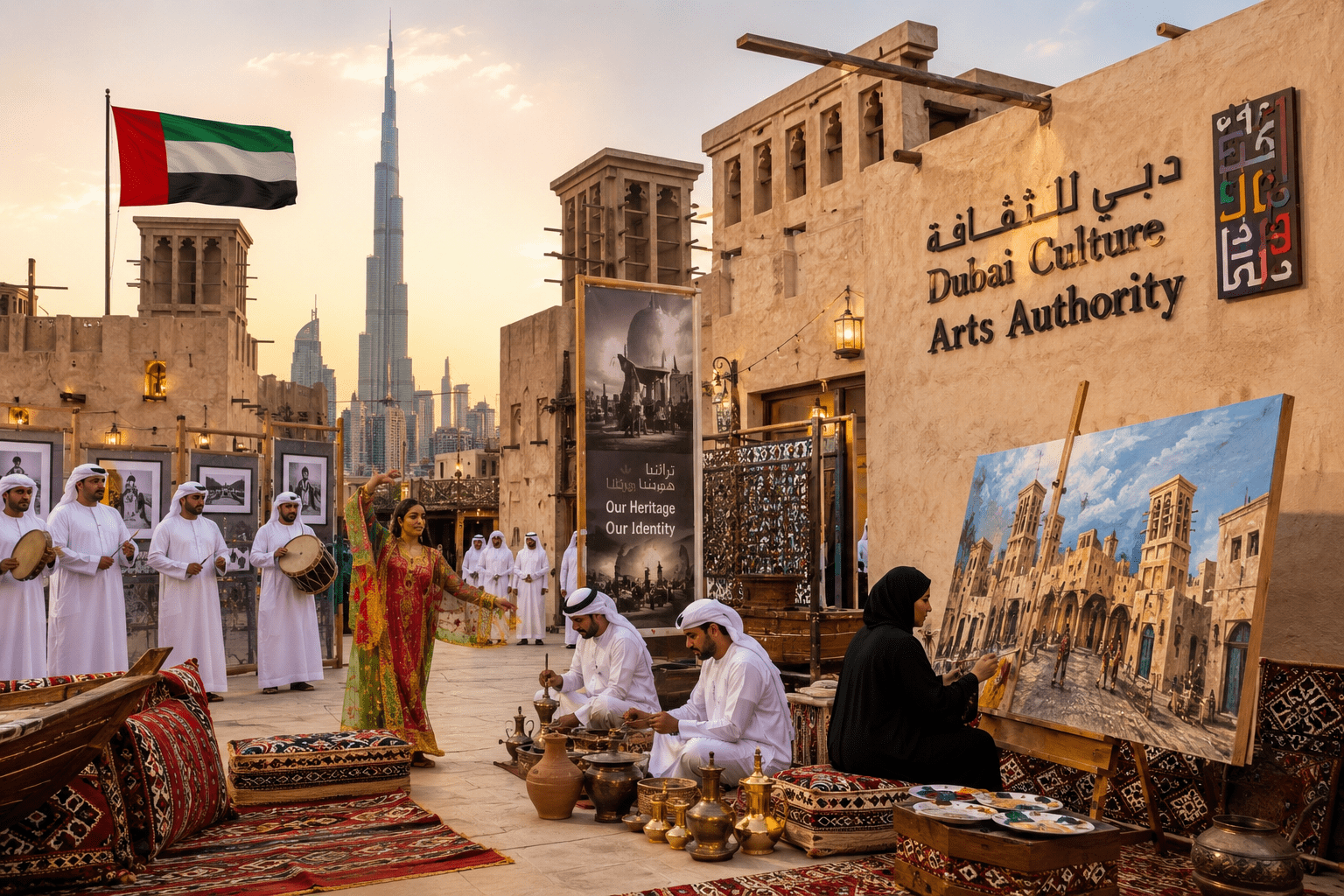
ToggleMost people land in Dubai chasing the skyline. They come for the Burj Khalifa, the man-made islands, the malls with aquariums built into the walls. But spend more than a few days here and you start noticing something underneath all that glass and steel: a city that still remembers where it came from. That’s Dubai Culture in a nutshell, the layer of the city that doesn’t show up on a postcard but shapes almost everything else, from how people greet you at a souk to why certain neighborhoods look nothing like the rest of the skyline. Understanding it doesn’t just make you a more polite visitor. It changes what you notice. A wind tower stops being decorative architecture and becomes a genuinely clever pre-air-conditioning cooling system. A cup of gahwa handed to you isn’t just coffee, it’s a small ritual with centuries behind it. This guide walks through what Dubai Culture actually means, the history that built it, and the government body, the Dubai Culture & Arts Authority, working to keep it alive while the city keeps building upward.
What Is Dubai Culture?
Dubai Culture refers to the traditions, values, customs, and creative life of Dubai, shaped by its Emirati and Bedouin roots, Islamic faith, and decades of trade with people from across the Gulf, South Asia, East Africa, and beyond. It shows up in everyday hospitality, in traditional food and dress, in historic neighborhoods along Dubai Creek, and in a modern arts scene that’s grown fast over the past two decades. It’s worth saying plainly: Dubai isn’t just a business hub with a few old buildings kept around for tourists. The old and new sit side by side on purpose. Walk from the glass towers of Downtown Dubai to the wind-tower houses of Bur Dubai and you’re not leaving the “real” Dubai behind, you’re seeing the two halves of the same identity. Emirati culture places heavy weight on family, generosity, and hospitality, values that trace directly back to Bedouin traditions, when survival in the desert depended on taking in strangers and sharing what little you had. Islamic customs shape daily rhythms too, from the call to prayer heard five times a day to the fasting and communal iftars during Ramadan. None of this is frozen in a museum case. It’s lived, daily, by the people who call this city home.
History and Evolution of Dubai Culture
Long before oil or towers, Dubai was a modest fishing and pearl-diving settlement along the creek. Bedouin tribes moved through the surrounding desert, and their traditions around hospitality, oral poetry, and community became the backbone of what would later be called Emirati culture. Pearl diving was brutal, seasonal work, and it built a culture of resilience and close-knit family units that still shows up in how Emiratis talk about their grandparents’ generation. Trade came next. Dubai Creek turned the settlement into a stopover for merchants moving goods between India, Persia, and East Africa, and that constant contact with outsiders is a big reason Emirati identity has always had a cosmopolitan streak baked in, rather than being closed off. Islam arrived centuries earlier and became the moral and legal foundation of the region, shaping everything from dress to social conduct to architecture, since even the wind towers built for natural cooling were designed with privacy and modesty in mind. Then oil was discovered in the 1960s, and the pace of change went from gradual to dizzying. Sheikh Rashid bin Saeed Al Maktoum poured revenue into infrastructure rather than sitting on it, and Dubai began the transformation into the global city it is now. What’s easy to miss is that this transformation was never meant to erase what came before. The government has spent real money and real political capital protecting Al Fahidi, restoring old souks, and building institutions whose entire job is heritage preservation. That tension, between rapid modernization and deliberate memory-keeping, is basically the whole story of Dubai Culture in the last fifty years.
What Is the Dubai Culture & Arts Authority?
The Dubai Culture & Arts Authority, often shortened to Dubai Culture, is the government entity responsible for developing and protecting Dubai’s cultural and creative sectors. It was launched on March 8, 2008, by Sheikh Mohammed bin Rashid Al Maktoum, Vice President and Prime Minister of the UAE and Ruler of Dubai, as part of a broader push to give the emirate a serious cultural identity to match its economic one. Sheikha Latifa bint Mohammed bin Rashid Al Maktoum currently chairs the organization. Its mission, in plain terms, is to put Dubai on the global cultural map, keep national heritage preserved and recognized, give local talent room to grow, and make sure culture and the arts contribute meaningfully to the economy rather than sitting off to the side as a nice-to-have. In practice that means the Authority oversees a wide portfolio: several of the city’s heritage monuments, multiple museums, and branches of the Dubai Public Libraries system all fall under its umbrella, along with cultural centers, art residencies, and annual events. Over the years its responsibilities have grown. The Al Jalila Cultural Centre for Children was brought under its structure in 2020, and the Mohammed Bin Rashid Al Maktoum Knowledge Foundation was affiliated with it in 2021, both moves that widened its reach well beyond simple museum management into education, youth programming, and knowledge-sharing.
How the Dubai Culture & Arts Authority Preserves Heritage
Heritage preservation sounds abstract until you see what it actually involves on the ground, and the Dubai Culture & Arts Authority handles a surprising range of it. Dubai museums under its care include long-standing institutions and newer additions that document everything from Bedouin life to the pearling era to the country’s formation in 1971. Historical districts like Al Fahidi get active restoration work, not just a plaque and a rope barrier, with original coral-stone buildings and wind towers maintained to look and function the way they did a century ago. Archaeological sites scattered around Dubai, some predating Islam, fall under its research and protection remit as well. Libraries matter here too, since the Dubai Public Libraries network run under the Authority isn’t just about lending books, it’s positioned as a tool for cultural education, hosting talks, workshops, and community programming aimed at keeping Arabic literature and local history accessible. Cultural education more broadly is a recurring theme in the Authority’s work, whether that’s school partnerships, youth heritage programs, or public events tied to national holidays. None of this happens passively. Restoration projects require ongoing funding, skilled labor familiar with traditional building materials, and constant balancing between authenticity and practical safety standards for the visitors who walk through these spaces every day.
Art and Creativity in Dubai
If heritage preservation is one arm of the Authority’s work, building a contemporary creative economy is the other, and it’s grown into something genuinely substantial. Public art has become part of the city’s visual language, with installations appearing in metro stations, along the creek, and in redeveloped districts. Contemporary art galleries cluster most famously in Alserkal Avenue, a converted industrial area in Al Quoz that’s now one of the region’s most respected gallery districts, hosting everything from experimental photography to large-scale installation work. Dubai Opera, opened in 2016 in a dhow-shaped building overlooking Burj Khalifa, brought world-class performance venues to a city that didn’t really have one before, and it’s since hosted everything from ballet to concerts to film premieres. Annual events add momentum too. Art Dubai draws galleries and collectors from across the region every spring, while the Sikka Art Festival, run directly by the Authority, gives space specifically to emerging Emirati and UAE-based artists inside the Al Fahidi neighborhood, which is a nice full-circle touch given the setting. Dubai Design Week and the broader creative economy push have positioned design, fashion, and digital art as genuine industries here, not just hobbies, with government backing behind talent incubators and residency programs like A.I.R Dubai. The result is a city that now supports a real arts ecosystem, from grassroots studios to internationally recognized institutions, largely because the Authority treated creativity as economic infrastructure rather than an afterthought.
Emirati Customs and Traditions
Getting the basics of local etiquette right goes a long way in Dubai, and most of it comes down to respect rather than rigid rule-following. Greetings matter, and a simple “As-salamu alaykum” is appreciated even from visitors who don’t speak Arabic beyond that. Arabic hospitality runs deep, so if you’re invited into someone’s home or a business majlis and offered gahwa and dates, it’s polite to accept at least a small amount, since refusing outright can come across as cold. Dress codes are more relaxed in tourist areas and hotels but noticeably more conservative in public spaces, government buildings, and older neighborhoods, where covering shoulders and knees is the safer default, especially for women. Ramadan etiquette deserves particular attention if you’re visiting during the holy month, since eating, drinking, or smoking in public during daylight fasting hours is considered disrespectful and, in some cases, can actually get you in legal trouble, even though private venues and hotels usually accommodate non-fasting visitors. Photography etiquette is another one people overlook, since photographing Emirati women, especially in traditional dress, without asking first is considered intrusive, and the same courtesy applies to photographing people inside mosques or private homes. None of these customs exist to make visitors feel unwelcome. They’re the practical expression of a culture built on modesty, family, and mutual respect, and treating them seriously is usually met with warmth rather than suspicion.
Traditional Emirati Food
Food tells you almost as much about a culture as its history does, and Emirati cuisine draws from Bedouin, Persian, Indian, and East African influences layered over generations of trade. Machboos is probably the closest thing to a national dish, a spiced rice preparation usually made with chicken, lamb, or fish, seasoned with dried lime, saffron, and a blend of warm spices that gives it a flavor distinct from other regional biryanis. Harees, a slow-cooked wheat and meat porridge pounded down to a smooth, almost creamy texture, shows up constantly during Ramadan and Eid celebrations. Balaleet, a sweet vermicelli dish often topped with a savory omelet, is a breakfast staple that manages to be both dessert and main course at once, which sounds odd until you actually try it. Luqaimat, small deep-fried dough balls drizzled in date syrup, are the dessert you’ll see at nearly every gathering, and they disappear fast. Dates themselves are less a food item and more a cultural symbol, tied to hospitality, Ramadan iftars, and the pre-oil economy when date palms were a genuine economic lifeline. And no meal or social visit really concludes without gahwa, Arabic coffee brewed with cardamom and sometimes saffron, poured in small cups and refilled continuously as a sign of generosity until the guest gives the traditional hand wobble signaling they’ve had enough. If you want a deeper look at where to actually track down these dishes around the city, our guide to Emirati food in Dubai covers the neighborhoods and restaurants worth prioritizing.
Cultural Places to Visit
A handful of places do more to explain Dubai Culture than any museum plaque could. The Al Fahidi Historical Neighbourhood, with its coral-stone buildings, narrow lanes, and dozens of wind towers, is the single best-preserved window into pre-oil Dubai, and it’s also home to the Sheikh Mohammed Centre for Cultural Understanding, which runs cultural meals and open Q&A sessions specifically designed to help visitors ask the questions they’re usually too nervous to ask. We’ve covered Al Fahidi in more depth here if you want a full walking guide. Dubai Creek itself, the natural saltwater inlet that built the city’s original economy, is still active with abra boats ferrying passengers across for a fraction of a dirham, and the creekside souks selling spices, textiles, and gold sit exactly where merchants have traded them for over a century. The Etihad Museum, built on the site where the UAE’s founding leaders signed the union agreement in 1971, does an excellent job explaining how seven separate emirates became one country. Traditional souks, particularly the Gold Souk and Spice Souk in Deira, are still functioning markets rather than tourist reconstructions, and haggling is genuinely expected. If you’re looking to go further off the well-trodden path, this list of hidden places in Dubai includes several cultural sites most visitors never find on their own.
Why Understanding Dubai Culture Matters
Cultural awareness isn’t just a box to tick before a trip, it genuinely changes the quality of the experience. Travelers who understand basic etiquette get warmer receptions from locals, run into fewer awkward misunderstandings, and end up seeing parts of the city that stay invisible to people who treat Dubai purely as a luxury shopping destination. It also protects you practically, since ignorance of local laws around dress, public behavior, or Ramadan conduct can lead to real consequences, not just dirty looks. Beyond the individual traveler, respectful tourism supports the broader goal the Dubai Culture & Arts Authority has been working toward for over fifteen years: making sure Dubai’s growth doesn’t come at the cost of its identity. Every visitor who takes the time to learn a bit of the history, try the food with some context, or ask before taking a photo is, in a small way, reinforcing that heritage preservation matters here, not just as government policy but as something the whole city benefits from.
Final Thoughts
Dubai Culture is easy to miss if you never look past the skyline, but once you start noticing it, it’s genuinely hard to unsee. It’s in the wind towers still standing in Al Fahidi, in the cup of gahwa handed to a stranger, in the deliberate work the Dubai Culture & Arts Authority does every year to keep museums, libraries, and heritage sites from being an afterthought in a city obsessed with what’s next. Understanding even a fraction of this history and etiquette turns a standard Dubai trip into something with more depth, and it shows a level of respect that locals genuinely notice. Whether you spend an afternoon in Al Fahidi, try machboos for the first time, or just learn how to greet someone properly, you’re engaging with the version of Dubai that existed long before the towers went up, and will likely outlast most of them too.
Frequently Asked Questions (FAQ's)
Dubai Culture refers to the traditions, customs, and creative life of Dubai, rooted in Emirati and Bedouin heritage, Islamic values, and centuries of trade influence, alongside a fast-growing contemporary arts and design scene.
The Dubai Culture & Arts Authority manages Dubai’s museums, heritage sites, public libraries, and cultural events, working to preserve local heritage while supporting the growth of arts, design, and the creative economy.
It was launched on March 8, 2008, by Sheikh Mohammed bin Rashid Al Maktoum, Ruler of Dubai, as part of a strategy to build up the emirate’s cultural sector alongside its economic development.
The Al Fahidi Historical Neighbourhood is widely considered the best starting point, with its preserved coral-stone architecture, wind towers, museums, and the Sheikh Mohammed Centre for Cultural Understanding offering guided cultural sessions.
Visitors should dress modestly in public spaces, avoid eating or drinking in public during Ramadan daylight hours, ask before photographing people, and expect warm hospitality, including offers of Arabic coffee and dates.
Both. Contemporary galleries in Alserkal Avenue and events like Art Dubai sit alongside traditional crafts and heritage-focused events like the Sikka Art Festival, which specifically supports Emirati and regional artists.
