
Table of Contents
ToggleIf you’re weighing up Sharjah for a business setup and you’ve landed on Hamriyah Free Zone, chances are you’re in manufacturing, trading, logistics, or something that needs actual physical space, not just a laptop and a flexi-desk. That’s really the whole point of Hamriyah. It’s built for businesses that need a warehouse, a port, or a factory floor, not a virtual office package.
This guide walks through what Hamriyah Free Zone actually offers, what it costs, how it compares to Sharjah’s other free zones, and what the registration process looks like once you decide to go ahead.
What Is Hamriyah Free Zone?
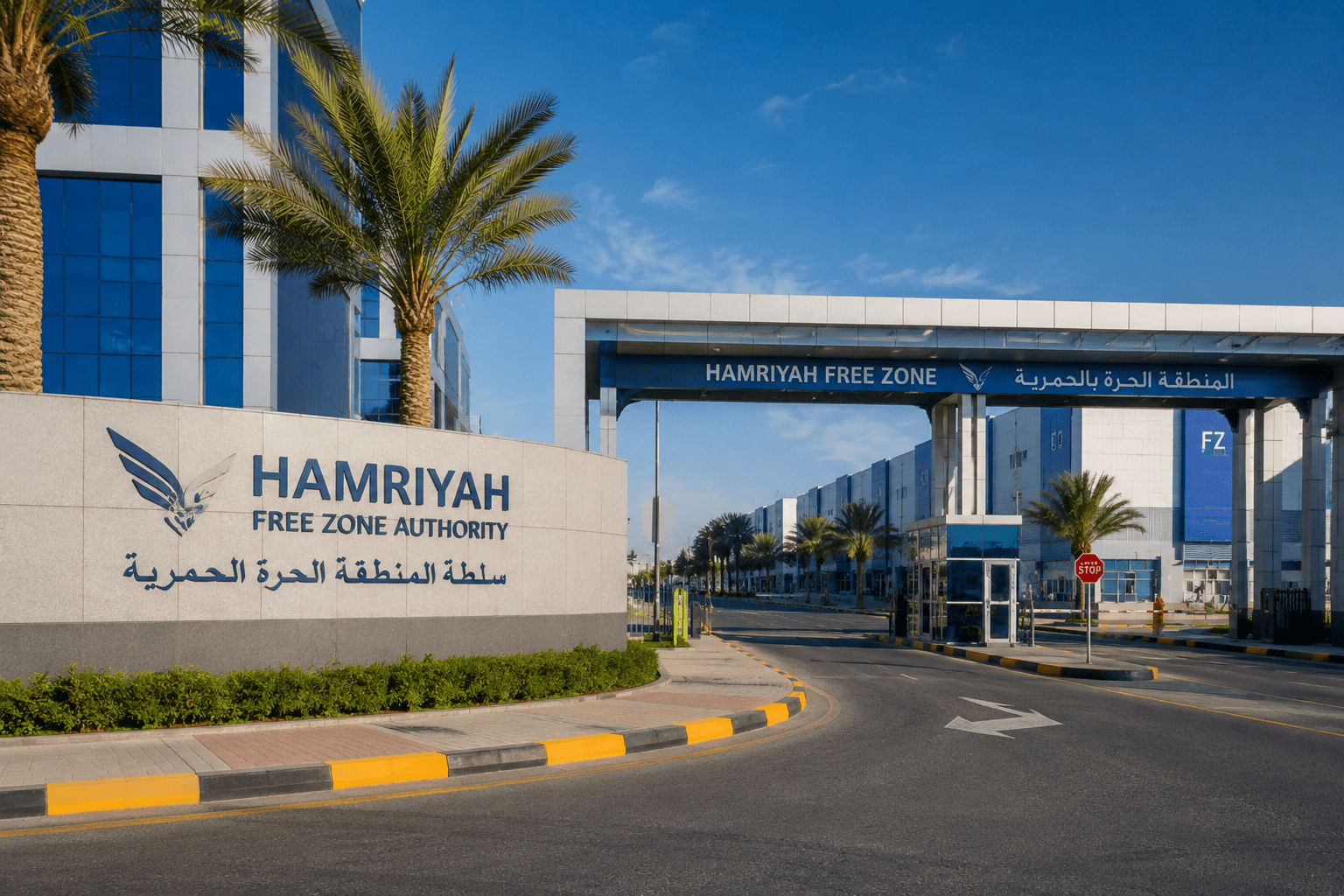
Hamriyah Free Zone Authority (HFZA) was established in 1995 by Emiri Decree in the Emirate of Sharjah, UAE. It’s the second-largest free zone in the country after JAFZA in Dubai, and it’s built around something most free zones simply don’t have: its own deep-water seaport.
The zone spans over 24 square kilometers of industrial and commercial land, with a 14-meter deep port and a 7-meter deep inner harbor. Today it’s home to more than 6,500 companies from over 160 countries, spanning sectors like oil and gas services, petrochemicals, steel fabrication, general trading, food production, and logistics.
Sharjah, worth noting, is the only emirate with coastline on both the Arabian Gulf and the Gulf of Oman, which is part of why Hamriyah’s port access matters so much for companies shipping to markets across the Gulf, the Indian subcontinent, and East Africa.
Hamriyah Free Zone License Types
HFZA issues three main categories of license, and which one you need depends entirely on what your business actually does:
Industrial License
Covers manufacturing, processing, and assembly of physical goods. This is the flagship license at Hamriyah and the one that drives most of the zone’s economic activity, think steel fabrication, chemical processing, or general manufacturing.
Commercial (Trading) License
Covers import, export, re-export, and distribution. If you’re moving physical goods rather than making them, this is usually the category you’ll fall under.
Service License
Covers professional and consultancy-type activities that don’t require warehouse or factory space.
Unlike some free zones that bundle almost any activity under one generic trading license, Hamriyah’s classification is more specific, which reflects how industrial the zone actually is.
What Does It Actually Cost?
This is where a lot of guides get vague, so here’s the honest picture: license costs at Hamriyah vary quite a bit depending on who you ask and what package you’re quoted, and the range you’ll see across different sources is genuinely wide, anywhere from around AED 5,000 at the low end up to AED 15,000 or more, depending on whether you need warehouse space, how many visas you want, and what your business activity actually is.
A few cost components to budget for beyond the base license fee:
- Office or warehouse space, a small flexi-desk setup costs far less than a 200 sqm warehouse, and warehousing alone can start from around AED 56,000–70,000 depending on size and lease terms
- Visa allocation, most packages include one visa; additional visas cost extra and depend on your office size
- P.O. box rental, a recurring annual cost, usually modest
- Security deposits and Emirates ID processing, often left out of the headline quote
One thing worth flagging honestly: HFZA’s own fee guide states that license fees exclude visa processing, security deposits, and Emirates ID issuance, so whatever number you’re initially quoted, budget for it to move. Always confirm current pricing directly with the free zone authority before committing, since these numbers shift.
Key Benefits
- 100% foreign ownership, no local sponsor required
- Zero personal income tax and no corporate tax on qualifying free zone income
- 100% repatriation of capital and profits
- Direct access to Hamriyah Port, including deep-water berths capable of handling vessels up to 60,000 DWT, bulk cargo handling, liquid bulk terminals, and Ro-Ro facilities
- Land leases of up to 25 years, renewable for a further 25 years
- Multi-currency operations with no foreign exchange restrictions
- Competitive lease rates compared to Dubai’s industrial free zones
Hamriyah vs SAIF Zone vs SHAMS
Sharjah actually has several free zones, and it’s easy to pick the wrong one if you don’t know the distinctions:
- Hamriyah Free Zone, the industrial and maritime zone, built for manufacturing, heavy industry, and anything needing port access
- SAIF Zone, positioned near Sharjah International Airport, better suited to trading and lighter manufacturing that moves by road or air
- SHAMS (Sharjah Media City), geared toward media, publishing, marketing, and creative businesses, with lower-cost virtual office packages
If your business needs a warehouse, deals in bulk goods, or ships internationally by sea, Hamriyah is generally the right call. If you’re a trading SME moving smaller volumes, SAIF Zone might work out cheaper. If you’re not moving physical goods at all, SHAMS is probably overkill to skip past.
The Setup Process, Step by Step
- Decide on your license type and business activity. This determines almost everything else, office requirements, visa quota, and cost.
- Submit your application to HFZA along with passport copies, a business plan, and supporting documents.
- Choose and sign a lease for your office, flexi-desk, warehouse, or industrial plot, depending on what your license requires.
- Receive your trade license and certificate of incorporation once approved.
- Apply for visas for yourself and any staff, including medical tests and Emirates ID processing.
- Open a UAE corporate bank account, which typically takes a couple of weeks once your license is in hand.
Much of this can now be handled through HFZA’s online investor portal, so a physical visit to the UAE isn’t always required for the initial registration steps, though you’ll need to be present for visa stamping and biometrics eventually.
Is Hamriyah Free Zone Right for Your Business?
If your business needs physical space, sea freight access, or deals in regulated goods like chemicals or industrial materials, Hamriyah is a genuinely strong option — and often more cost-effective than Dubai’s equivalent industrial zones like JAFZA, without giving up much in terms of infrastructure. If you’re a smaller trading operation or don’t need warehouse space at all, it’s worth comparing quotes against SAIF Zone or SHAMS before committing, since Hamriyah’s industrial orientation means its minimums tend to run a bit higher than zones built for lighter business activity.
For businesses eyeing the wider Sharjah market beyond free zones — including what’s driving the emirate’s broader economic momentum — UAE Weeklys’ coverage on why entrepreneurs are moving startups to the UAE is worth a read, along with their roundup of Dubai’s best business opportunities if you’re comparing emirates before deciding where to set up.
For the most current fee schedules and application requirements, go straight to the source: the Hamriyah Free Zone Authority’s official site and the UAE Ministry of Economy & Tourism’s profile on Hamriyah Free Zone are both good starting points before you request a quote from a setup consultant.
Frequently Asked Questions (FAQ's)
Generally yes for industrial and warehouse-heavy businesses, though the gap depends on exactly what you’re comparing.
Not for the initial application, but you’ll need to be there eventually for visa stamping and Emirates ID biometrics.
You can trade under the commercial license, though the zone’s infrastructure really favors businesses moving physical goods at scale.
Hamriyah is built around its own deep-water port, while SAIF Zone sits near the airport and suits road or air-based trading.
How long does it actually take to get a license issued?
