
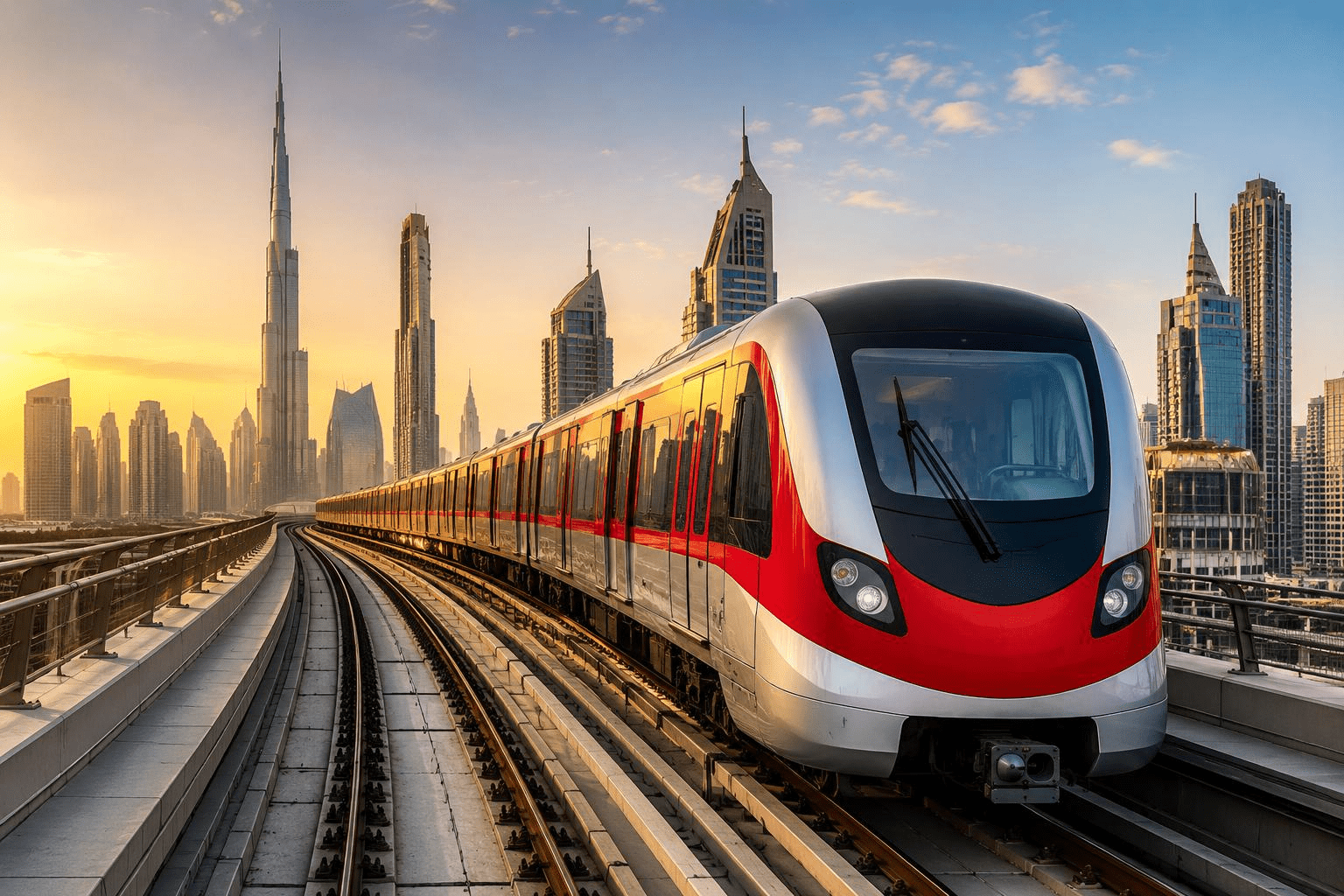
Dubai’s metro system is one of the most reliable in the world, and for good reason: it was designed to work at scale, in heat, and for millions of daily users from the very start.
The red line metro Dubai is the city’s main arterial route, stretching 52 kilometres from Dubai International Airport in the east to the communities near Jebel Ali in the west. It connects business districts, shopping malls, tourist landmarks, and residential areas in a single continuous corridor. This guide covers the full list of Dubai metro red line stations, how the route connects to other transport modes, current timings, fare zones, and the Nol Card system.
Complete List of Dubai Metro Red Line Stations
The Dubai metro red line stations span the length of the city, each one serving a specific neighbourhood, commercial zone, or transit hub.
Centrepoint is the eastern terminus in Al Rashidiya, close to Mirdif City Centre. Airport Terminal 3 and Airport Terminal 1 are both underground stations within Dubai International Airport, giving travellers a direct link from the terminal to the metro. Terminal 3 handles most Emirates airline traffic; Terminal 1 serves flydubai and other carriers. GGICO (Dubai Airport Free Zone) is primarily used by business travellers in the free zone.
City Centre Deira gives direct access to one of Dubai’s oldest shopping malls and the surrounding Deira district. Al Rigga is a practical stop for travellers staying in budget hotels in Deira, within walking distance of restaurants and the creek area.
Union is the first major Red-Green Line interchange and also connects to the main bus terminus for services heading to Sharjah, Ajman, and Fujairah. BurJuman is the second interchange, located directly below BurJuman Centre shopping mall in Al Karama.
World Trade Centre is the primary stop for conference and exhibition visitors. Emirates Towers and Financial Centre serve the DIFC corridor, with Gate Village, Gate Avenue, and most of the financial district’s major offices within walking distance.
Burj Khalifa/Dubai Mall is the most-used station on the entire network, connecting via a climate-controlled bridge to Dubai Mall and placing passengers steps from the Burj Khalifa, Dubai Fountain, and Souk Al Bahar. Business Bay serves the commercial and residential towers along the Dubai Creek extension.
Mall of the Emirates has ground-level access into the mall itself, making Ski Dubai and over 630 stores immediately accessible. Dubai Internet City is the main stop for the UAE’s tech hub, with regional offices for Microsoft, Google, and Oracle nearby.
Sobha Realty and DMCC both connect to the Dubai Tram for onward access to Dubai Marina Walk, JBR, and The Beach. Jabal Ali is the branching point where the route splits toward UAE Exchange (main line) and the Route 2020 corridor heading south to Expo City. UAE Exchange is the western terminus of the main line, serving Al Furjan and Jebel Ali.
Red Line Metro Route Dubai Explained
The red line metro route Dubai follows Sheikh Zayed Road for most of its central stretch, which is what makes it so effective. The road is Dubai’s main highway, and running parallel to it means the metro connects every major commercial district along the corridor without any of the traffic.
From Centrepoint in the east, the route passes through the airport zone, crosses through Deira at Union and BurJuman, then continues south-west along Sheikh Zayed Road through the financial district, Downtown Dubai, and on to Dubai Marina and Jebel Ali.
The Green Line interchanges at Union and BurJuman give access to areas the Red Line does not reach directly, including the Gold Souk and Al Ghubaiba. From Jabal Ali, the Route 2020 branch extends to Expo City Dubai through Al Furjan, Jumeirah Golf Estates, and Dubai Investment Park.
Dubai Metro Red Line Timings
Dubai metro red line timings follow a consistent weekly schedule, with variations depending on the day.
From Monday to Saturday, the metro opens at 5:00 AM and runs until midnight. On Fridays, service extends to 1:00 AM to accommodate the start of the weekend. On Sundays, the metro opens later at 8:00 AM, so if you have an early Sunday commitment near an airport terminal or a morning meeting, plan accordingly.
During peak hours on weekdays, which are roughly 7:00 to 9:00 AM and again from 5:30 to 7:30 PM, trains run every 3 to 4 minutes. In off-peak periods, the frequency drops to around every 7 minutes. During special events, Ramadan, Eid, and National Day weekends, the RTA often announces extended operating hours of up to 2:00 AM.
The most practical advice for commuters is to travel between 9:30 AM and 4:30 PM if flexibility allows. Trains at these times are noticeably less crowded and the journey is more comfortable. For real-time schedules and service updates, the RTA’s S’hail app is the most reliable tool, and it also handles Nol Card top-ups.
Dubai Metro Fares and Nol Card System
All fare payments use the Nol Card system. Cash and credit cards are not accepted at the turnstile.
Fares are calculated by zone. A single zone journey costs AED 3, two zones cost AED 5, and three or more zones cost AED 7.50. Gold Class fares run roughly double for access to the quieter premium cabin.
There are four Nol Card types. The Red Ticket is a disposable card for occasional single journeys. The Silver Card is the standard rechargeable option at AED 25 (including AED 19 credit), which suits most tourists and short-term residents. The Gold Card costs AED 100 and provides Gold Class cabin access. The Blue Card is issued to students, senior citizens (60 and above), and People of Determination, carrying discounts and free travel entitlements.
Children under five travel free. A Day Pass at AED 20 (standard) or AED 40 (Gold) gives unlimited metro, tram, and RTA bus travel for one calendar day. For tourists covering multiple destinations in a day, the Day Pass usually saves money over individual fares.
Major Attractions Accessible Through the Red Line
The red line metro Dubai connects to most of Dubai’s major tourist destinations without needing a taxi.
Burj Khalifa and Dubai Mall are reached from the Burj Khalifa/Dubai Mall station, connected to the mall by a climate-controlled bridge. Museum of the Future is walkable from Emirates Towers or World Trade Centre stations, both on Sheikh Zayed Road.
Dubai International Airport is served by the underground Airport Terminal 3 and Terminal 1 stations, giving travellers one of the most seamless airport-to-metro connections anywhere in the world.
Dubai Marina and JBR are accessible from DMCC or Sobha Realty stations, where the Dubai Tram picks up and runs along the waterfront. Mall of the Emirates has ground-level station access directly into the mall, with Ski Dubai a few minutes’ walk from the platform.
Expo City Dubai is reached via the Route 2020 branch from Jabal Ali, taking roughly 30 minutes from Union station.
Benefits of Using the Red Line Metro Dubai
The red line metro Dubai saves money first. A cross-city ride that costs AED 30 to 50 by taxi comes down to AED 7.50 by metro. For daily commuters, that gap compounds quickly over a month.
It also removes the unpredictability of road traffic. Sheikh Zayed Road sees significant congestion at peak hours, and the metro runs on a fixed schedule that road conditions cannot touch. Safety is built in at every level: CCTV throughout, automatic platform barrier doors, and driverless fail-safe operation.
Accessibility is comprehensive. Every station has wheelchair ramps, lifts, and tactile paths for visually impaired passengers. People of Determination travel free with a registered Blue Nol Card. Children under five travel free as a standard policy.
Why the Dubai Metro Remains One of the World's Best Transit Systems
The trains are clean, the stations are air-conditioned in a city that regularly exceeds 40 degrees Celsius in summer, and peak-hour frequency means rarely waiting more than four minutes. That combination of basics, delivered consistently, is harder to achieve than it sounds.
The station design adds to the experience. Each station is themed around one of five concepts: Earth, Water, Air, Fire, and UAE Heritage. No two stations feel the same, which makes navigation intuitive.
Driverless automation means no driver fatigue, no crew-change delays, and a schedule that holds. Since earning the Guinness World Record in 2011 for the longest single-line driverless metro in the world, the Dubai Metro has continued to refine its operations year on year.
For transport and infrastructure updates, the UAE news section at UAEWeeklys covers ongoing developments.
Final Thoughts
The red line metro Dubai is more than a commuting option. It is the thread that connects the city’s most important districts, from the international airport in the east to the industrial and residential zones in the west, and everything along Sheikh Zayed Road in between.
Understanding the Dubai metro red line stations, how the route connects to other lines and transport modes, the current timing schedule, and the Nol Card fare system gives you a genuine advantage in navigating the city. Whether you are here for a weekend, relocating for work, or planning a longer stay, the metro removes friction from daily movement in a way that no other mode of transport in Dubai can match.
For more guides on living, travelling, and doing business in the UAE, visit UAEWeeklys.
Frequently Asked Questions (FAQ's)
The Red Line runs from Centrepoint in the east to UAE Exchange in the west, with a Route 2020 branch extending south to Expo City Dubai.
The Red Line has 35 stations in total, including the Route 2020 branch extension to Expo City.
Answer: The metro runs from 5:00 AM to midnight Monday through Saturday, from 5:00 AM to 1:00 AM on Fridays, and from 8:00 AM to midnight on Sundays.
The Burj Khalifa/Dubai Mall station on the Red Line is the closest, with a direct footbridge to Dubai Mall and the tower base.
Fares start at AED 3 for a single zone and go up to AED 7.50 for three or more zones using a standard Nol Card.
The Silver Nol Card is best for most tourists, offering a rechargeable balance for use across the metro, tram, and buses.
Yes, the Red Line runs seven days a week, with varying opening times depending on the day.
